
Under the IFC and NFPA 1 framework, dead‑end fire apparatus access roads are limited in length before a turnaround is required, and specific turnaround configurations are prescribed.
Base dead-end limit
- IFC Section 503.2.5 and Appendix D103.4: A dead-end fire apparatus access road longer than 150 ft must be provided with an approved turnaround.[1][2][3][4]
- NFPA guidance is aligned: if the access road dead end exceeds 150 ft (about 46 m), a turnaround space is required.[5][6]
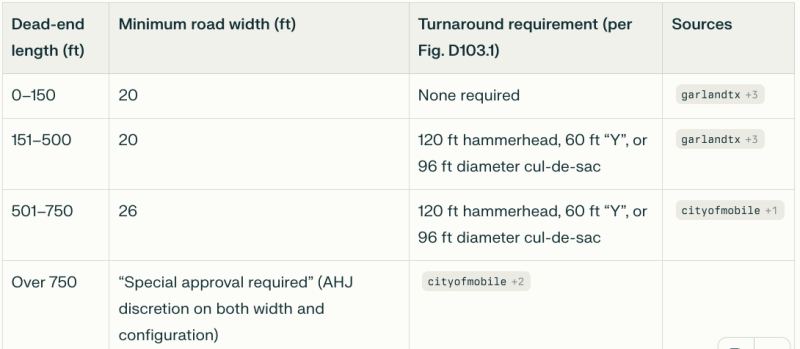
D103.4
Turnaround location
- Commentary and guidance state that the turnaround must be located at the end of the road or within 150 ft of the end so that apparatus do not need to back up more than 150 ft.[7][3][4]
Types of allowed turnarounds
IFC Appendix D Figure D103.1 and Table D103.4 show typical options. Common ones are:[2][3][7][1]
- Cul‑de‑sac (often 96–120 ft diameter, local standard varies).[4][7][2]
- Hammerhead “T” turnaround.[3][7][4]
- “Y”‑type turnaround.[7][3]
- Other configurations specifically approved by the fire code official that provide equivalent maneuvering space for the design apparatus.[6][2][3]
Local amendments and extensions
- Many AHJs adopt the 150 ft limit directly; some, like Arvada Fire and North Collier Fire, allow modest extensions (for example, 25 ft additional) in constrained sites if approved.[8][9]
- Some jurisdictions add exceptions where a dead end over 150 ft may omit a turnaround if all buildings beyond 150 ft have alternate compliant access or are sprinkled to a specified level.[10][6]
How to phrase it in practice
In IFC-based jurisdictions, you can generally state: an approved turnaround for fire apparatus is required where a fire apparatus access road is a dead end exceeding 150 ft in length, with the turnaround placed at or near the end and configured per IFC Appendix D Table D103.4 and Figure D103.1 or as otherwise approved by the fire code official.[1][2][3][6]
- https://www.tupeloms.gov/wp-content/uploads/2023/12/19.-Fire_Compliance_Guide_IBC2018.pdf
- https://codes.iccsafe.org/content/IFC2018P6/appendix-d-fire-apparatus-access-roads
- http://www.campusfiresafety.org/Portals/0/Documents/Code Corner, International Code Council/Jun10-CodeCorner.pdf
- https://www.bismarcknd.gov/DocumentCenter/View/47886/Site-Design-Requirements-for-Fire-Department_201707261643516528-
- https://www.nfpa.org/news-blogs-and-articles/blogs/2022/12/19/how-to-maintain-building-and-equipment-access-for-the-responding-fire-department
- https://terpconsulting.com/portfolio_page/the-ins-and-outs-of-fire-department-access/
- https://www.ci.missoula.mt.us/DocumentCenter/View/70234/STD-Dead-End-Fire-Apparatus-Access-Road-Turnaround
- https://arvadafireco.gov/DocumentCenter/View/223/2019-02_Extension-of-Dead-end-Fire-Apparatus-Access-Road-Length_2021-PDF
- https://northcollierfire.com/wp-content/uploads/2024/08/ACC-15-01-Dead-End-Roads-09-2020_20240820.pdf
- https://www.nyc.gov/assets/fdny/downloads/pdf/about/Chapter-05.pdf
- https://codes.iccsafe.org/s/IFC2024P1/appendix-d-fire-apparatus-access-roads/IFC2024P1-Pt07-AppxD-SecD103.4
- https://codes.iccsafe.org/content/IFC2021P1/appendix-d-fire-apparatus-access-roads
- https://www.thebuildingcodeforum.com/forum/threads/fire-apparatus-access-road-dead-end-turn-around.9541/
- https://www.nfpa.org/news-blogs-and-articles/blogs/2021/01/08/fire-apparatus-access-roads
- https://codes.iccsafe.org/s/IFC2021P1/appendix-d-fire-apparatus-access-roads/IFC2021P1-Pt07-AppxD-SecD103.4