
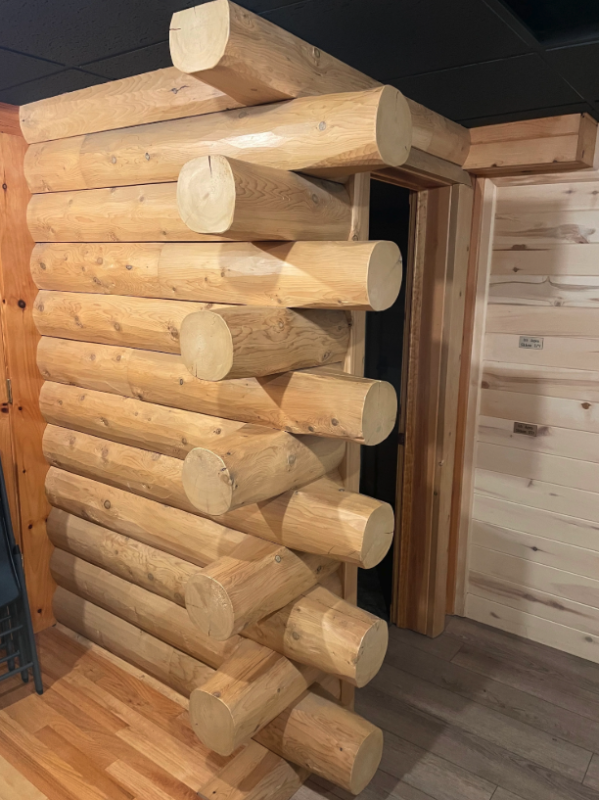
Log extensions are the parts of log walls that extend out past the outside corners of log walls. They are high-risk areas and should be inspected closely for both moisture and structural issues.
Why corner log extensions matter
- Exposed end-grain at corners absorbs water faster than the rest of the log, making decay more likely at the log ends.
- Overly long extensions are more prone to rot unless protected by generous roof overhangs or other design features.
- Overly short extensions are more vulnerable to splitting that can weaken the notch and corner integrity.
Key inspection checkpoints
When you’re at the corner extensions, focus on:
- Moisture and decay indicators: Dark discoloration, mildew, moss, fungal growth, white powdery residue, or thick/failed stain are all red flags for chronic moisture and early rot.
- Soft or hollow wood: Tap the log ends and corner courses with a small hammer or tool handle; a hollow or dull thud suggests internal decay that may not be obvious on the surface.
- Probe resistance: Use an awl or thin screwdriver at suspicious ends and checks; easy penetration or crumbly wood indicates rot depth and potential structural compromise.
- Corner notch type and fit: Note the notch style (saddle-notch, dovetail, etc.), how tightly logs fit, and whether there are visible gaps that can admit water and insects at the extensions.
- Checks and upward-facing surfaces: Look for checks on the tops and bottoms of the extensions that can collect water; unsealed, upward-facing checks increase decay risk.
- Finish and sealant: Evaluate stain/film thickness, peeling, UV damage, and whether log ends and checks are properly sealed with log-specific sealants rather than generic caulk.
Observations to document in a report
For home inspection reporting purposes, it’s useful to:
- Describe the configuration of the extensions (length, exposure, roof overhang protection, orientation to prevailing weather).
- Identify visible damage: surface rot, deep checking, splitting, insect frass, fungal growth, or prior repairs/epoxy patches at log ends.
- Comment on water management influencing the corners (roof design, gutters/downspouts, splash-back, grade, nearby vegetation, sprinklers).
- Recommend further evaluation/repair by a log home restoration or qualified log builder if there is suspected structural compromise at corner bearing logs or extensive decay at multiple extensions.
Practical field technique example
On a corner stack with exposed round-log tails:
- Visually scan all exposed ends from bottom to top for darkening, moss, heavy checking, and previous patchwork.
- Tap each suspect end with a hammer; if one sounds hollow compared to adjacent logs, probe to confirm soft or decayed material.
- Note whether the roof overhang shelters the corner; if the tails extend well beyond the drip line with minimal finish, flag the condition as at elevated risk for decay and monitor or repair as needed.