
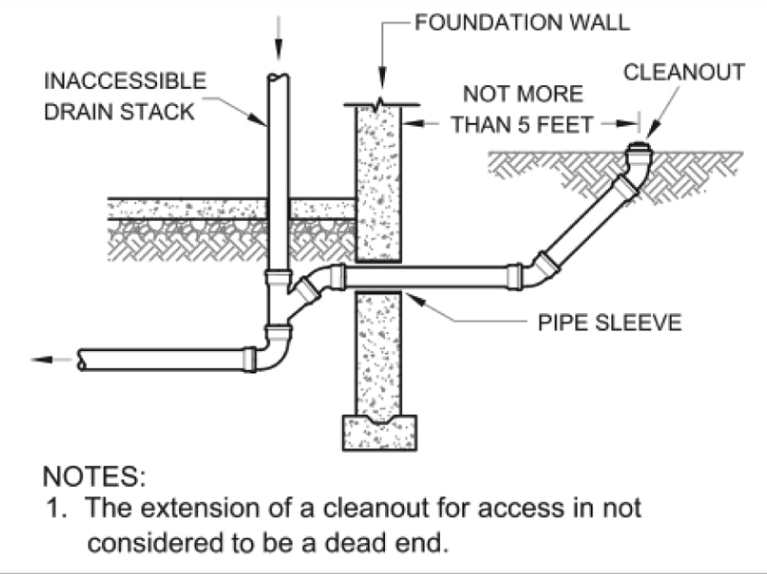
Although requirements have changed over the years, plumbing cleanouts are required wherever the drainage system needs accessible points for clearing blockages, both inside the building and in the building sewer outside, with exact locations governed by plumbing code.
Typical required locations
- At or near the junction of the building drain and the building sewer (usually where the main house drain exits the foundation, inside or just outside the wall).
- Within a specified distance of where the building drain connects to the sewer lateral, commonly within about 10 feet of that connection, and extended to or above finished grade.
- At required intervals along long horizontal runs of the building sewer or building drain (for example, every 50–100 feet, depending on the adopted code and local amendments).
- At each significant change in direction of the building drain or building sewer, typically where the line turns 45 degrees or more.
- At the base of certain vertical stacks or where stacks transition to horizontal building drains, so that a cleaning tool can be run both up and down the line.
Fixture and trap cleanouts
- Many fixtures (such as sinks and some showers) effectively have cleanout access at the trap or via a removable trap section, which allows clearing localized clogs in that branch.
- These trap cleanouts are usually not the primary “code-required” building cleanouts for the main drain, but they do satisfy fixture-branch access requirements in many jurisdictions.
Practical inspection note
In practice, you’ll often see: one main cleanout at or near the foundation, additional cleanouts at long runs or sharp turns, and smaller access points at fixtures and branch lines, with details dictated by the specific plumbing code and local amendments in force.