
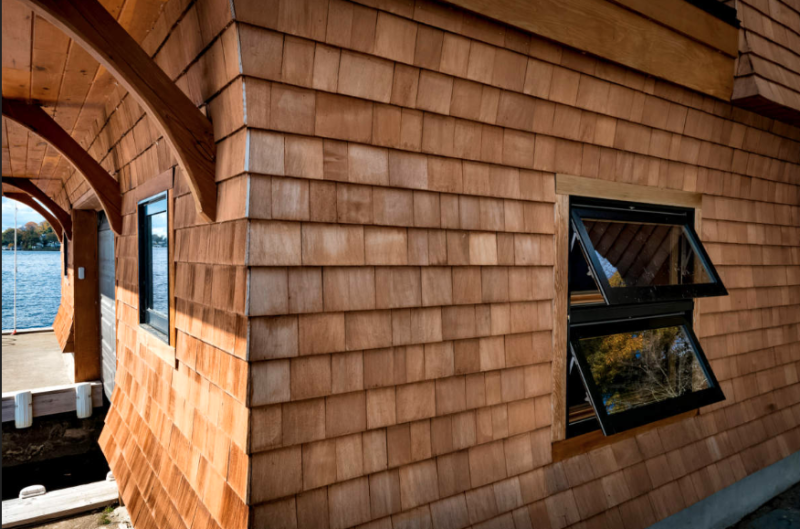
Basic Installation
- No interlayment allowed;
- Spacing between shingles in the same course:
- 1/4-inch to 3/8-inch.
- Minimum shingle width: 3 inches ;
- Minimum sidelap 1 1/2 inches ;
- Joints in less than 10% of shingles should align in alternate courses;
- In lower quality shingles, the centerline of the heart should be offset 1 1/2 inches from vertical joints in adjacent courses.
- Hot dip galvanized nails only, no electro-galvanized! Stainless steel within 15 miles of salt water
Condition
- Cupped or curled shingles
- Splitting
- Erosion
- Missing shingles
- Biological growth
- Exposed fasteners
Aging/Failure Characteristics
Curling: Some shingles will curl over time and curling often appears in patches on the roof, indicating that some bundles were made up of shingles predisposed toward curling. Curling seldom causes leakage.
Cupping: Wood shingles are also subject to cupping, meaning they curl across their width instead of across their length.
Splitting: As time passes, moisture cycling will cause shingles to develop splits. Small cracks appear first at the tips of butts and over time propagate upwards, eventually developing into splits that extend clear through the shingle along its length. An older split affected by natural weathering will be the same color as the rest of the shingles, typically greyish brown, and will have smooth, rounded over edges.
A newer split with causes like impact or footfall, will be orange in color and will have sharp edges.
Erosion: Erosion it typically caused by flowing or dripping water. The source may be an overhanging gutter or downspout, or even runoff falling from the butt of an overlying curled shingle.
Decay: Decay typically develops first in shingle butts, since this is the thickest part and holds moisture like a sponge.
Displacement: Over time, thermal cycling causes metal fasteners to expand and contract. This enlarges the nail holes in the wood shingles, and in the substrate to which they are fastened. At the same time, moisture cycling causes shingles (and eventually the substrate) to expand and contact further degrading the connection between fasteners and wood. This overall degradation of the fastener connection reduces the resistance of the roof to wind damage.