
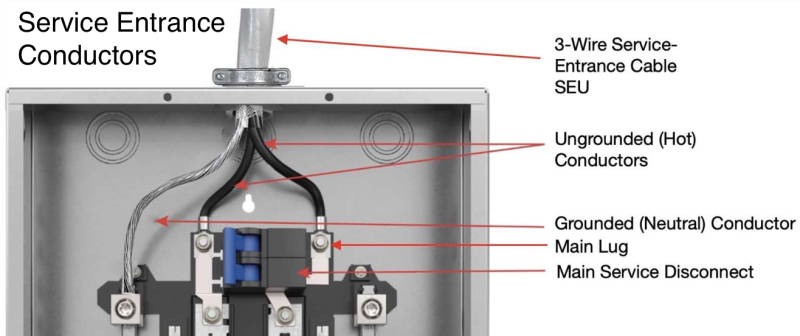
Copper Conductors
Amperage Rating |
Copper Conductor Size |
|---|---|
| 100 | 4 AWG |
| 110 | 3 AWG |
| 125 | 2 AWG |
| 150 | 1 AWG |
| 175 | 1/0 AWG |
| 200 | 2/0 AWG |
| 225 | 3/0 AWG |
| 250 | 4/0 AWG |
| 300 | 250 kcmil |
| 350 | 350 kcmil |
| 400 | 400 kcmil |
(sf.gov, Scribd — NEC Table 310.12, LearnMetrics)learnmetrics+1
Aluminum (or Copper-Clad Aluminum) Service Entrance Conductors
(sf.gov, Scribd — NEC Table 310.12, LearnMetrics)scribd+1
Notes for field use
-
This is the NEC 310.12 “dwelling exception” table — it applies only to the main service or main feeder conductors for a one-family dwelling or an individual unit of a two-family/multifamily dwelling, on a single-phase 120/240V (or 208Y/120V feeder) system, and only when no ambient-temperature or conduit-fill adjustment factors apply. It reflects a built-in 83% diversity allowance on residential loads, which is why these sizes run smaller than the general-purpose ampacity Table 310.16 would otherwise require for the same amperage.nassaunationalcable+1
-
Sub-panel feeders and any non-dwelling (commercial) service must instead be sized off Table 310.16 directly, which yields one size larger at most amperages (e.g., 200A would need 3/0 Cu or 250 kcmil Al rather than 2/0 Cu / 4/0 Al).wirefillchart
-
Aluminum service conductors are always sized at least one, often two, AWG steps larger than copper for the same amperage due to aluminum’s lower conductivity — worth flagging in reports since undersized aluminum SEC relative to this table is a common defect finding.
-
The grounding electrode conductor minimum is separate (typically 4 AWG copper minimum for most residential services) and is not part of this ampacity table.